
My Story
My Story
Excerpts from my upcoming autobiography "Dimension of Destiny, The Lindsey Baine Story".
*Some names have been taken out for security reasons.
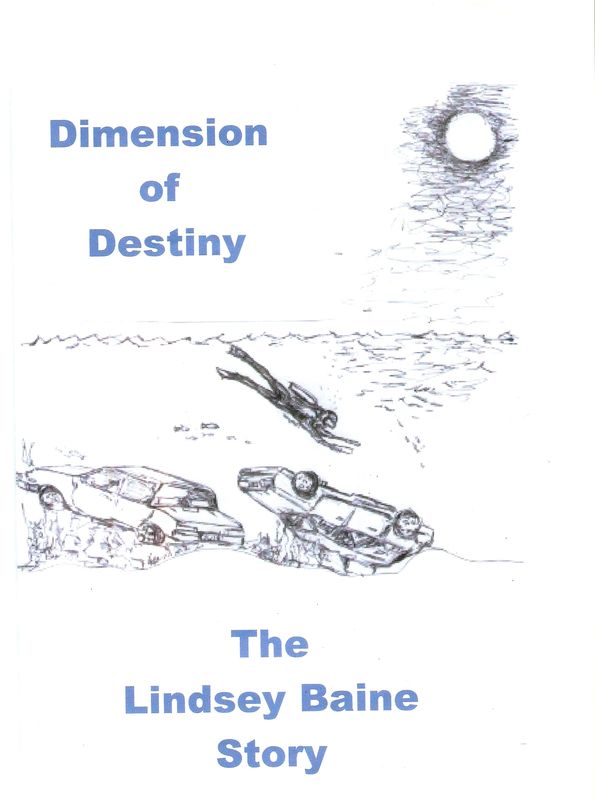
From farm ponds to world renown lakes this author has taken on some of the country's most dangerous diving and has made it his trademark. Author and Master Scuba Diver Lindsey Baine takes you into the underworld of submerged vehicles. The whys, the whats and the whos behind all the reasons their sunk. The author shares dozens of secrets that he has learned based on his thirty-three years of search & recovery experience. Find out why you will never look at your local boat ramp the same again but how it alone is the entrance to the dimension of destiny.
My story begins in Alabama in a small farm community atop Sand Mountain in a place named after Mount Pisgah where Moses saw the Promise Land for the first time; a place simply named Pisgah with a population of 450 at the time. I was reared on a farm to be a part time farm boy. My daddy always had some kind of chore waiting for me to do like slopping hogs, mending fences, hoeing corn or the garden, plowing fields, working on the tractor, cutting firewood, building out sheds for animals and the list goes on. It was sun up to sun down and then some. During the summers I would work for hire hoeing watermelons, cotton or at the local potato shed working in the potato fields sometimes working on the digging machine or driving a potato truck from the fields to the shed.
Being a kid during the seventy's I still found time for high school sports. I played football and was pretty good at it for a part time farm boy. In a game at North Sand Mountain I was mad that the coach wouldn't let me and my teammates go eat at the local burger bar before leaving for the game. I had not eaten lunch that day so as to save my lunch money for the burger bar. It was a before the game highlight to meet some of my teammates up at the Eagles Nest and relax a while by listening to the jukebox. This anger carried over to the football game as I was playing left defensive end and after sacking the quarterback at least ten times the opposing team decided it was time to get rid of me for the game. They decided to send a tackle, 2 half backs with the quarterback following them around my end. I saw them coming and said to myself,"this is gonna hurt." I aimed for the middle of them, spread out my arms and kept my eye on the ball. When the dust settled, all five of us was on the ground. I got up head spinning, helmet crooked to the right with a mouth full of grass and got tackled again by my teammates wondering to myself, what the heck? Our side of the stands was up and shouting, BULL, BULL, BULL . I had become a star with one play and man was I ever hungry. That night forevermore I became known as The Bull. To this day thirty-one years later no one in Pisgah calls me Lindsey, they call me Bull. Some say it didn't happen like that, but my wife Denise assures me that it did happen just that way.
Now as far as finding stolen vehicles it was as easy as playing football. The first stolen vehicle I ever found was off a cliff known as Gorham's Bluff. There's a town there now but around 1976 it was nothing but a soybean field on the edge of a bluff of Sand Mountain in the middle of nowhere. Having lived not far away I was always riding my bicycle over to the bluff. I liked the wind blowing up from the hollow and watching the eagles fly around. The scenery was out of this world with a full view of Coon Creek and the winding Tennessee River in the background slowly coming from the Snodgrass bridge in Stevenson. There is a cave under the bluff that I played in and a hole in the bluff called the Scuttle Hole that one could climb down to the base of the bluff through, so being a kid I was doing what kids like to do, explore. So one day I was over at the bluff and saw some car parts, quarter panels, tops, cut-up car bodies still soaked in gasoline down below off one of my favorite sitting areas. Not knowing what to do about it I went back home and my grandmother had me call Chief Jim Kirby of the Pisgah Police Department. He came by and picked me up, we went over to the bluff, I showed him what was below. We ended up climbing down the bluff and checking for vehicle identification numbers on the vehicles. That was about all there was to that. Seems like Investigator Bell from the Sheriff's Department was there that day as well.
A couple of years after finding those chopped up vehicles I began driving as a teenager. I had a 1962 Fairlane, 289 2 barrel , stick shift, mint condition, red with white top and white seating with mags. It was beautiful. A dream car that only now I can appreciate.
Anyway, one night sitting at the supper table, daddy asks me right out of the blue if I wanted to learn how to scuba dive. I was surprised because I could barely swim. I never had learned to swim because being from the farm there wasn't time to go swimming. Anyhow, he was wanting to take scuba classes and wanting me to go with him as a buddy. I agreed.
Scottsboro Scuba School it was called. Organized by an engineer at Bellefonte Nuclear Plant as a side gig. On a hot, stuffy July evening in 1979 daddy and I got to Bob's house with several others already there getting together their supplies for the first scuba class beginning that night. Bob's garage was supplied like a scuba shop with all kinds of scuba gear hanging for sale. It was all new Dacor gear. Bob fitted me with fins, mask, snorkel and a dive booklet; we were ready for class. But wait a minute, my daddy backed out at the last minute and left me holding the fins.
First question out of my mouth was, "Do I need to know how to swim to take scuba lessons?" The reply was, "Nope why should you know how to swim your going to be under the water with air anyway." "Okay," I said. That's good enough of an answer for me.
I got certified as a Open Water Diver in July 1979 at the age of seventeen.
My dad intended for me to dive for muscle shells. That was what it was all about I soon found out. One problem. I didn't know anyone to teach me the business. Soon however the bottom fell out of the muscle shell business anyway with Japan learning to raise their own.
I got a call one day that the students of Scottsboro Scuba School was going to start a dive club and wanted me to attend the first meeting at Western Sizzling in Scottsboro. I went. Several folks were there that night and we took up a collection to fund an air filling valve needed by the Scottsboro Fire Department to fill our scuba tanks with. The nearest dive shop was thirty-five miles away and the fire department said they would help us out if we donated the valve to them. We got it and they kept it in a lock box for our use only. Over the upcoming weeks I was feeling left out as the meetings were moving more toward diving in Florida and the Bahamas. I didn't have money to go to those places. Another fellow at the meeting felt the same way named John. We got to be buddies and he introduced me to diving for stolen vehicles. It blew my mind to learn of such a thing but it sounded up my alley.
It was the summer of 1980 before John and I found a submerged vehicle together in a hole that was shown to me by a friend in Flat Rock. John decided it was worth a shot after I showed him the site and we jumped in. Not long after hitting the bottom at 20ft deep I ran into an overturned vehicle. John and I were connected by a buddy rope because of the no-visibility conditions. It was my first submerged vehicle a Monte Carlo. He had contacts within the Sheriff's Dept and they quickly arrived to pull out the vehicle.
Soon after that find I had the bug for sure. John begin showing me places around on the river that were already active dumping places for stolen vehicles. The most notorious was D-9 still my most active place that I find submerged vehicles to this date. The first time I know of any submerged vehicles being found there was a couple of years before I began diving when eighteen were found there at one time. John and I have lost touch over the years as I moved to Atlanta and had a stay in the Army but I continue to dive the places he showed me.
In December 1985 I found my first submerged vehicle on my own. In August 1980 I had begun a three year term in the Army. Once out of the Army I moved to Atlanta where I married my first wife a childhood friend of my Army roommate's wife. I didn't do that much diving from 1980 to 1985 in the river. I had dove extensively in Santa Rosa, New Mexico and Elephant Butte Lake in New Mexico while taking advanced scuba classes in the Army on the weekends in El Paso, TX while I was stationed at Ft. Bliss. During that time I was certified up to Advanced Open Water with three Specialty certifications.
In the summer of 1984 in Atlanta I began taking scuba classes to become a Master Scuba Diver as well as a Divemaster and completed that goal in that fall. In December 1985 I found another car in the same coal pit as John and I had found one five years earlier. I was actually trying out a new dry suit and ended up bumping my head on a car. I reckon destiny struck.
The Sheriff's Department Investigator that came out for that pull ask me if I would go dive a hole for him in the river. I said sure. He took me down to D-9 where I had never dove but once and told me to jump in that I should find several submerged vehicles. After a few minutes I surfaced with the tag number of five. Mr. Bell and I had already known each other for years as he had been married to my next door neighbors daughter. I also knew him from drug education classes in high school. He showed me a few more dumping sites in the area as well as did another Department Deputy that I knew well. My finds were beginning to add up and I loved it.
I would go over the Sheriff's Department and fish abit after I got to know several of the officers. Some would tell me to go try that pond over yonder or try that fishing hole on the back forty. I even hung out at the Fire Department in Scottsboro and the fellows there always knew of some out of the place hole to find cars. None of the tells ever panned out but the experience of diving some of those places and just finding the places were a good learning curve.
I guess I took on my own to keep diving the sites that were producing vehicles. It was like not having any ideal what you would find under the Christmas tree on Christmas morning. It was exciting to just dive and find whatever there was to find. The Sheriff's Department seemed to appreciate my efforts so I kept on finding what others didn't want found. To date I have found a total of 130 vehicles submerged add another twenty for burnt, chopped-up and rusted away ones .
I descend on my Grandmother _ Baine’s side of the family the McCurdy’s from a rich royal line with three paths to King Edward III, King of England 1327-77. Those paths go through his sons, John of Gaunt and Lionel of Antwerp. King Edward became famous for the Hundred Years’ War and from him every English King to King George III also claimed to be King of France as well.
I also have descended from King Donald Ban, King of Scotland, the origin of my family Sir name of which the family coat of arms shows a direct line from Zebulon, a lost tribe of Israel. My Bain family came to America from Argillshire, Scotland in the late 1600’s. As an American my lineage wouldn’t be complete without having descended from a Revolutionary War hero. I descend from two. My GGG-Grandfather William Bain fought with Duffy’s Riflemen during the Revolutionary War. He was granted land in Arkansas for his service that he gave to a neighbor.
William Pace a GGGG-Grandfather is another hero of which I descend from, from my Grandma Estelle's side of the family. He descended from Richard “The Dean” Pace born in 1483 and served many positions within King Henry VIII’s Administration serving as Dean of Saint Paul’s, Vicar of Saint Dunstan’s in Stephany and as King Henry VIII’s Secretary. William was the bodyguard of General George Washington during the war and was granted two hundred acres of land in Scott County, Virginia by General Washington for his service. He is buried on that land now. His Great Grandfather Richard Pace had a plantation called Paces Paines where he had an Indian slave named Chanco that warned him about an impending Indian raid that became known as The Indian Massacre of 1622. This warning allow time to warn villagers that helped prevent the complete destruction of Jamestown, Virginia.
As my former boss Jack _ once told me. Be careful that you find a King in your lineage because you’re sure to find an outlaw as well. Words couldn’t have been truer. That outlaw is none other than John Wesley Hardin, the West’s most terrible outlaw that had killed over forty men in his short life of whom I am a cousin. A cousin to him was none other than Doc Holiday famous for the shootout at the OK Corral with the Earps. They as I descended from General Joseph Hardin the namesake of Hardin County, Tennessee.
My first Roden ancestor born in America was William Roden born in Lancaster County, Virginia and was later appointed Commissioner of Justice in 1671 by Lord Charles Calvert, Governor of Maryland.
My first Bain ancestor in America was Daniel Bean, the father of Robert Bean. Robert married Martha McDonald. It’s believed that he acquired land in Cabarrus County, North Carolina from Henry McCulloch that was granted land by the Crown of England.
Robert Bean had ten children, Daniel, John, Charles, Robert, Margaret, William, Alexander, Matthew, James and Nancy. From these children most of the southern state Bains descended. I descended from William. In 1801 after the death of Robert, the family changed their name back to Bain. William and his brother Alexander moved from the Popular Tent area of Cabarrus County, North Carolina in 1826 to Bellefonte Island in Jackson County, Alabama in hopes of gaining land in the Cherokee lands that were going to be opened for white settlement east of the Tennessee River. These lands didn’t open up till after the infamous Trail of Tears in 1835. My G-Great-Grandfather John Bain and his brother Allen helped removed the Indians from Sand Mountain. By then Alexander had moved on to a new home in Guntersville, Alabama building and operating a Gist Mill living amongst the Wakefield Indians. His son James Simpson Bain would eventually own 2300 acres in most of Guntersville State Park. William and his sons sold Bellefonte Island for a hundred dollars to the Starkey family and moved to Fackler, Alabama on new farms of forty acres each. William’s son Matthew gave up farming on his forty acres in 1849 and moved to Leon County, Texas. William’s son John my G-Great Grandfather chooses to be a sharecropper on the farm of Elias Barber in Bellefonte, Alabama. In 1853 he is killed accidentally by Elias Barber while turkey hunting in Bellefonte. His son George, my G-grandfather was four years old at the time of his father’s death and was taken by John’s sister Nancy Thornhill and reared on Sand Mountain in Rosalie, Alabama.
The Civil War tore my family as well as it did other families. Nancy Thornhill’s husband Bryant Thornhill had been crippled in a horse riding accident prior to the Civil War. He was known for his saddle making ability. One day soldiers came and rolled him off in a wheel barrow taking him to Atlanta, Georgia to help the war effort. He died in Atlanta, Georgia from disease contracted there. This motivated the young George Bain into entering as a Confederate Soldier at the age of fifteen. He served in the Home Guard protecting the community from Yanks.
George later became a preacher and pastored several churches in the area. He was the original owner of the land that now is the home of Pisgah High School. He was reared on land that is across from the present day New Home Baptist Church in Pisgah, Alabama. He was a good friend of Mr. Estes the founder of the school.
Daddy, the youngest son of Simpson Baine served in the National Guard during the Vietnam War with an Engineer outfit in Scottsboro, Alabama. He became a union carpenter as most of the Bain men were, his name is _ Bain but everyone calls him _ he married my mother _ in June of 1959 and I was their first child. Daddy began preaching early in my childhood and pastored at New Herman Baptist Church in Pisgah, Alabama. He pastored there for around fifteen years.
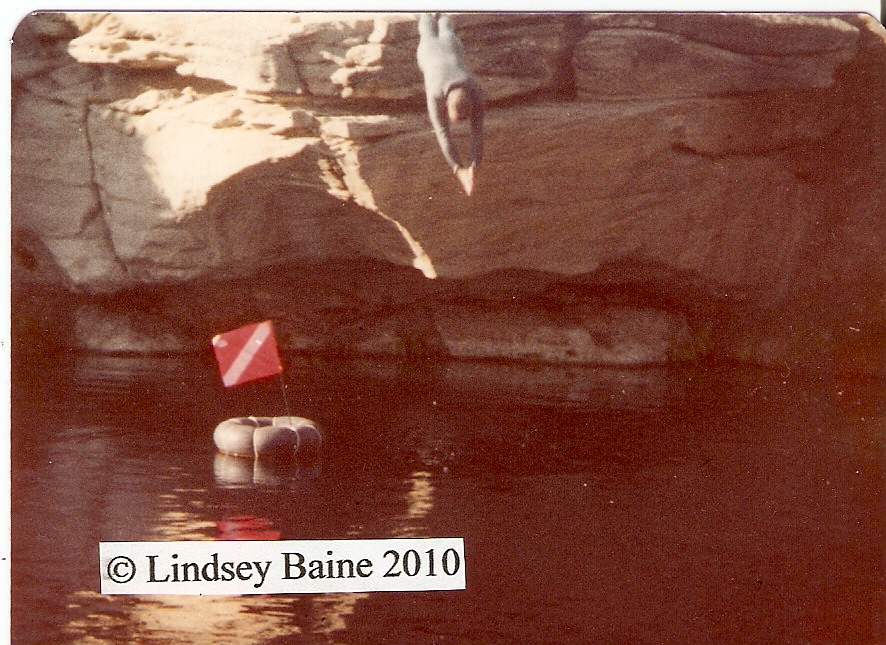
This is me jumping into the Blue Hole.
The Blue Hole was a round hole about one hundred foot round out in the middle of desert high country sitting I think at about 4600 feet above sea level. The water was blue as blue could be and was eighty feet deep. I went to the bottom several times but most loved to just dive around the edge at about forty feet and watch the diving activities at the bottom. It was probably the most fun I have ever had diving. This is where I obtained my high-altitude and deep diver certification. At the bottom was a steel plate that was positioned over a hole that went into a deeper two hundred and forty-foot deep room blocked off because of divers having been killed in it.
Elephant Butte Lake got its name from a huge hill in the lake that looked just like an Elephant…no joke. It sat just off in the distance from the Dam across from where we did our diving classes. I was certified as a limited visibility diver at Elephant Butte Lake because of its poor visibility.
Qualifications:
I have made a career total of over 2200 dives with over 1000 hours of underwater dive time in six states, three countries and two continents.
Certified by the Professional Association of Diving Instructors (PADI). My certifications include:
7/1979 Open Water Diver Certification, Scottsboro, AL; Instructed by Bob Butry Cert@Pensacola, FL
8/1981, Advanced Open Water Diver Certification, El Paso, Tx; Instructed by Phillip Godbold Cert@Elephant Butte Lake, NM
8/1981, Limited Visibility Diver Certification, El Paso, TX; Instructed by Phillip Godbold Cert@Elephant Butte Lake, NM
9/1981, High Altitude Diver Certification, El Paso, TX; Instructed by Phillip Godbold Cert@The Blue Hole, Santa Rosa, NM
10/1981, Deep Diver Certification, El Paso, TX; Instructed by Phillip Godbold Cert@The Blue Hole, Santa Rosa, NM
9/1984, Night Diver Certification, Smyrna, GA; Instructed by L.G. Garrard Cert@White's Quarry, White,GA
11/1984, Divemaster Certification, Smyrna, G; Instructed by L.G. Garrard Cert@White's Quarry, White,GA
12/1984, Rescue Diver Certification, Smyrna, GA; Instructed by L.G. Garrard Cert@White'sQuarry, White, GA
12/1984, Master Diver Certification, Smyrna, GA; Instructed by L.G. Garrard Cert@White'sQuarry, White, GA
11/2004, Emergency First Response, CPR Certification, Stockbridge, GA; Instructed by Bruce Brown
Below in the dive log begin pressure group means the calculated amount of nitrogen that I have in my body at the beginning of a dive. A=lowest amount possible and Z=largest amount possible without the need for a decompression chamber. The amount of nitrogen stored in the body is calculated by the actual bottom time plus the amount of bottom time on a previous dive the same day or within the past 24 hours also using the dive depth in the calculation. Nitrogen is stored in the body because the body does not use it so it takes time to breathe off the stored nitrogen in the blood. This is calculated using the amount of surface time between dives by determining time spent breathing it off. This time causes a M to drop to maybe a D as an example. Then when I go back in the water starting at D then it goes back up to maybe a F before I surface as as example. On some first dives of the day you will notice that I start at D. This is because I drive across Lookout Mountain going to the Tennessee River and cross an altitude of 2000 feet. This is like having already made two dives of a total of 29 minutes. It is safe to calculate two pressure groups per 1000 feet of crossed altitude which brings me to D and 29 minutes of residual stored blood nitrogen.
A few places I've dove:
- Coon Creek, AL
- Blowing Cave, AL
- Flat Rock Creek, AL
- Frog Pond, AL
- Jones Cove, AL
- Liches Creek, AL
- Little River, AL
- Little River Dams, AL
- Pisgah Coal Pits, AL
- Pisgah Gorge, AL
- Flat Rock Coal Pits, AL
- Tennessee River, AL
- Guntersville Lake, AL
- Mud Creek, AL
- Blue Hole, AL
- Fort Pickens Jetties, FL
- The Bridges @ Pensacola, FL
- Morrison Springs, FL
- Key West, FL
- Coosa River, GA
- Devil's Elbow, GA
- Etowah River, GA
- Chattahooche River, GA
- White's Quarry, GA
- Taylor Mtn Cave, GA
- Lake Allatoona, GA
- Lake Lanier, GA
- Blue Ridge Lake, GA
- Emerson Mine Pits, GA
- Blue Hole, Santa Rosa, NM
- Elephant Butte Lake, NM
- Rio Grande River, NM
- Tennessee River, TN
- Tims Ford Lake, TN
- Nickajack Lake, TN
- Bennett Lake, TN
- Devil's Step, TN
- Battle Creek, TN
- Rio Grande River, TX
- Baumholder Lake, Germany
- Barcelona, Spain
Quotes from the past:
Quote-"Hey, look over yonder it's a mannaquin; someone's trying to fool us into believing it's a body."
Fact-From the day we discovered a woman's body in a strip mine.
Quote-"Go diving down at the next boat ramp on the right; it's a 100 foot deep with at least 20 cars submerged."
Fact-Was 10 feet deep and nothing but mud.
Quote-Hey diver, you need to go back in, I know it's a car delivery truck with 10 cars on it out there and probably a school bus too."
Fact-After finding three cars in 15 feet of water off a boat ramp.
Quote-"You need to check out at least 300 feet from this cliff edge. They'll be plenty of cars out there because they jump them off here."
Fact-The running distance was only ten feet and the water below was 10 feet deep.
Quote-"Dive right here you'll find a few here."
Fact-The hole was 3 feet deep with 2 feet of silt.
Quote-"You wouldn't catch me in here. There's a catfish down there big as a car."
Fact-Before diving at the Stevenson River Bridge.
Quote-"Ain't no need in you diving this hole. You won't find a thing."
Fact-Told by a security guard protecting his nepnew before finding a vehicle.
Quote"Someday your going to be found in the trunk of a car with your scuba outfit still on."
Fact-Told by some wise cracks before finding three cars in the Tennessee River.
FAQ
(1) How did you know that vehicle was in the water?
I don't know. The only way I know that a vehicle is in the water is by diving to find whether or not one is present. When I do find one I notify the proper authorities. I do irregular recons of my dive sites all during the year to check for obvious tire prints that lead into the water, drag marks on rocks that lead into the water, oil and gas coming up out in the water that indicate a submerged vehicle and other signs that would lead me to believe a vehicle is submerged. There has been a lot of times when I have walked up to the edge of the bank at a few of my dive sites where I have seen one or more vehicles down in the water. Why someone else had not reported such a scene to authorities is unbeknownst to me.
(2) Do you ever find anything in the vehicles?
I do not tamper with the vehicles in any way. Whatever is in the vehicle stays in it for the investigators.
(3) How do you know where to look for submerged vehicles?
I have been shown most of my dive sites by Deputies, Policemen, Investigators, Constables, Wrecker Men past dive buddy and actively pursue sites that I hear about from bystanders.
(4) Do you ever find vehicles that have been freshly put in the lake?
Yes sometimes. If I'm on my game by diving as often as I should then sometimes I'm going to just be at the right spot at the right time but it's not often. I believe that it is to the benefit of everyone but the criminal that I find one at least within 30 days of it being sunk. I believe that Alabama insurance has to pay the car off within 30 days so if it is insurance fraud that has been committed then it I believe is an easier case to build for conviction if I find the vehicle within 30 days before the check is mailed to the owner of the vehicle. But it isn't often that I find one within that time frame due mostly to my weekly job load that keeps me to busy to dive or to tired to dive come the weekend. Then again I do not dive during the winter months unless in case of emergency.
(5) What are some of the methods used to find new vehicle dumping sites not previously known to you?
I use topographical maps to find secluded areas with a quarry or pond deep in the woods. I also use satelite imagery off the internet to take a closer look at quarries, ponds, boat ramps and other areas that could be used to dump a stolen vehicle. I also recon areas that I hear about from people that want to tell me stories of where they seen a submerged vehicle; most of these stories are just tall tales but I check them out anyway not all the stories have come up bogus.
(6) Do you ever dive with a buddy?
I have tried unsuccessfully to keep a diving buddy diving with me. I have provided dive gear, food, travel expense and shared the finds by fifty precent and still can't keep a buddy diving with me. The reason mostly is the travel time to and from dive sites and many have just pitched fits at the river current and mud they have to deal with once at the dive sites. Most of my diving is in low to no visibility. Some have not wanted to deal with the scrutiny involved in finding stolen vehicles. A past buddy that was an active police officer for a nearby agency stated, "his eyes have been opened to submerging crimes and he would never view a body of water the same again." My wife is usually with me and I've been able to count on her to at least go with me for the past nineteen years when no one else will.
This Website is copyrighted by Lindsey Baine. Premission to use any information printed or photographed must be granted in writing by the author Lindsey Baine. He can be reached at lindseypbaine@gmail.com